
A Friendly Guide to Opera: What It Is and How to Enjoy It
Few things carry quite as much undeserved baggage as opera. The word alone can conjure images of impenetrable foreign languages, dress codes, and performances that stretch past midnight. None of that should put you off.
At its heart, opera is storytelling through music. Singers perform dramatic roles, accompanied by a live orchestra, and the whole thing unfolds on a theatrical stage with costumes, sets, and lighting. Think of it as a play where the dialogue is sung rather than spoken. Some operas are tragic, some are wildly comic, and some are genuinely surprising in how immediate they feel.
This guide is written for anyone who is curious but unsure where to start. You don't need musical training or any background knowledge to enjoy it. Plenty of first-time opera-goers walk in knowing nothing and walk out wanting to book their next ticket.
Ahead, you'll find a plain-language explanation of what opera actually is, a walkthrough of how a typical performance works, and some practical suggestions for listening or attending your first show with confidence.
What Is Opera
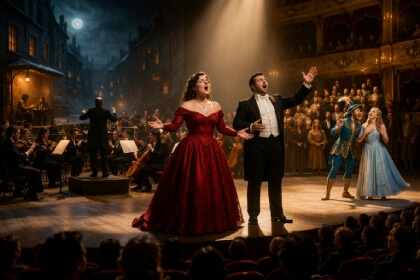
Think of it as theatre where almost every word is sung rather than spoken. Opera is an art form that combines singing, orchestral music, and stagecraft to tell a story. The music isn't background decoration. It carries the emotion, the plot, and the characters.
The text of an opera is called the libretto, which simply means "little book" in Italian. The libretto is the script. The composer then sets those words to music.
Within that music, you'll hear different vocal types. A soprano is the highest female voice, often cast as the heroine. A tenor is the highest common male voice, frequently the romantic lead. When two singers perform together, that's a duet. A larger group singing together is the chorus. Beneath them all sits the orchestra, the full ensemble of instruments that underpins everything.
So how does opera differ from a musical? Both tell stories through song, but opera relies entirely on trained classical voices with no microphones, and the orchestra plays a far more central dramatic role.
Puccini's La Bohème and Mozart's The Magic Flute are good starting points. Both are emotionally immediate, even on a first listen.
How an Opera Performance Comes Together
Walking into an opera house for the first time, you'll notice the sheer scale of what's involved. There's a full orchestra in the pit below the stage, a conductor leading them, singers in elaborate costumes, and an entire visual world built from sets and lighting.
Most operas are sung in Italian, German, or French. Don't let that put you off. Nearly every major opera house today displays surtitles - translated text projected above the stage - so you can follow the story line by line.
A typical performance opens with an overture, an orchestral piece that sets the mood before anyone sings a word. From there, singers move between recitative and aria. Recitative is the conversational, plot-moving singing that carries the story forward. Arias are the emotional showstoppers - think of the soprano's heartbreak in Puccini's La Bohème or the baritone's fury in Verdi's Rigoletto.
You don't need to catch every word to feel what's happening. Emotion travels through the music itself, through the voice, the orchestra, and the drama unfolding on stage.
Where to Start as a New Listener
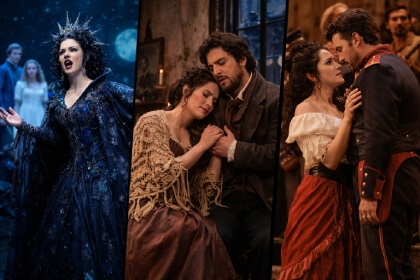
Three operas come up again and again as ideal starting points, and there are good reasons for that.
Mozart's The Magic Flute is a sensible first choice. It has a fairy-tale plot, comic characters, and music that ranges from playful to genuinely moving. The famous "Queen of the Night" aria alone is worth the price of admission. La Bohème by Puccini is another strong option. Set among struggling young artists in Paris, it's emotionally direct in a way that needs no explanation. The final act has made audiences cry for over a century. Carmen, by Bizet, moves fast and sounds immediately familiar. You've almost certainly heard its melodies before without knowing where they came from.
For your first experience, try a recorded highlights playlist on a streaming service before committing to a full performance. When you're ready for the real thing, look for a production that offers surtitles, the translated text projected above the stage, so nothing gets lost.
Check our glossary for unfamiliar terms, or browse our upcoming performances page to find something near you.
Opera Gets Easier Once You Begin
There is no requirement of having a music degree, nor should you have been watching concerts for a lifetime in order to enjoy an evening at an Opera house. What could revolutionize an
The Grammy Nomination for this disc means so much, as this has been the most important project of my artistic life. I won't ever get tired of the hashtags #DoPeace #TalkPeace! Thank you to ALL of you who have followed "In War & Peace: Harmony Through Music" from the start!
— Joyce DiDonato (@JoyceDiDonato) November 29, 2017